

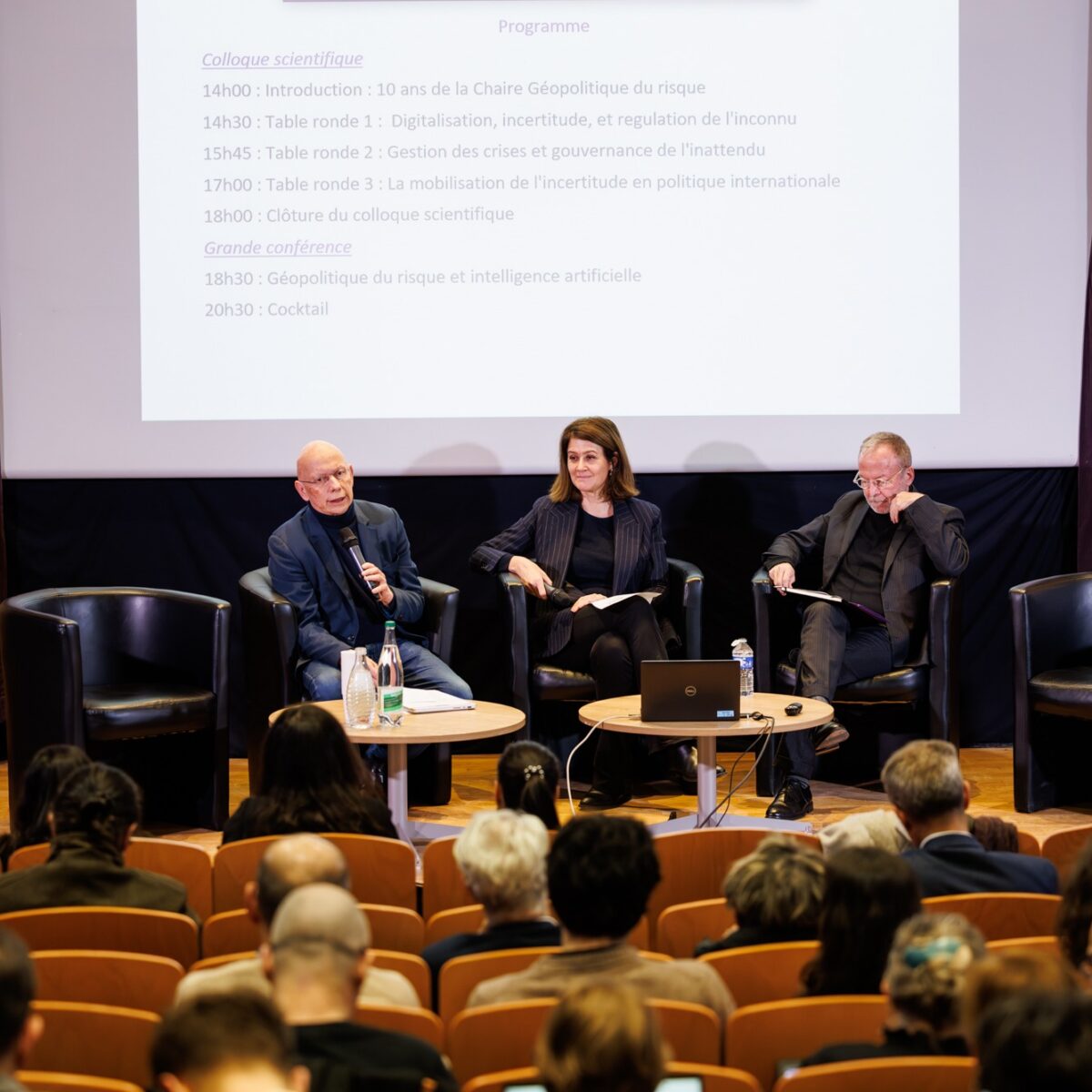
A renewed approach to risk
© Frédéric Albert
For the past ten years, the work carried out has helped shift the very notion of risk. It is no longer seen merely as an external hazard, but as a phenomenon embedded in contemporary social, political, and technological dynamics. Geological and energy risks, the digitalization of societies, and the ethical challenges of data management: the Chair has explored these dimensions by combining geopolitical analysis with normative reflection.
In the opening remarks, Frédéric Worms, Director of the ENS, emphasized how the geopoliticization of risk is transforming our relationship to knowledge and public decision-making. Ulrike Decoene, AXA Group’s Director of Communication, Brand, and Sustainability, highlighted the importance of a structured dialogue between academic research and economic actors in the face of global uncertainties.
Peter J. Burgess, Director of the Chair, then presented the new approach to risk that has emerged from ten years of work: a form of risk that is no longer external but internalized by societies, as well as one that is deeply intertwined with data and digitalization across the world.
Exploring the multiple dimensions of uncertainty
© Frédéric Albert
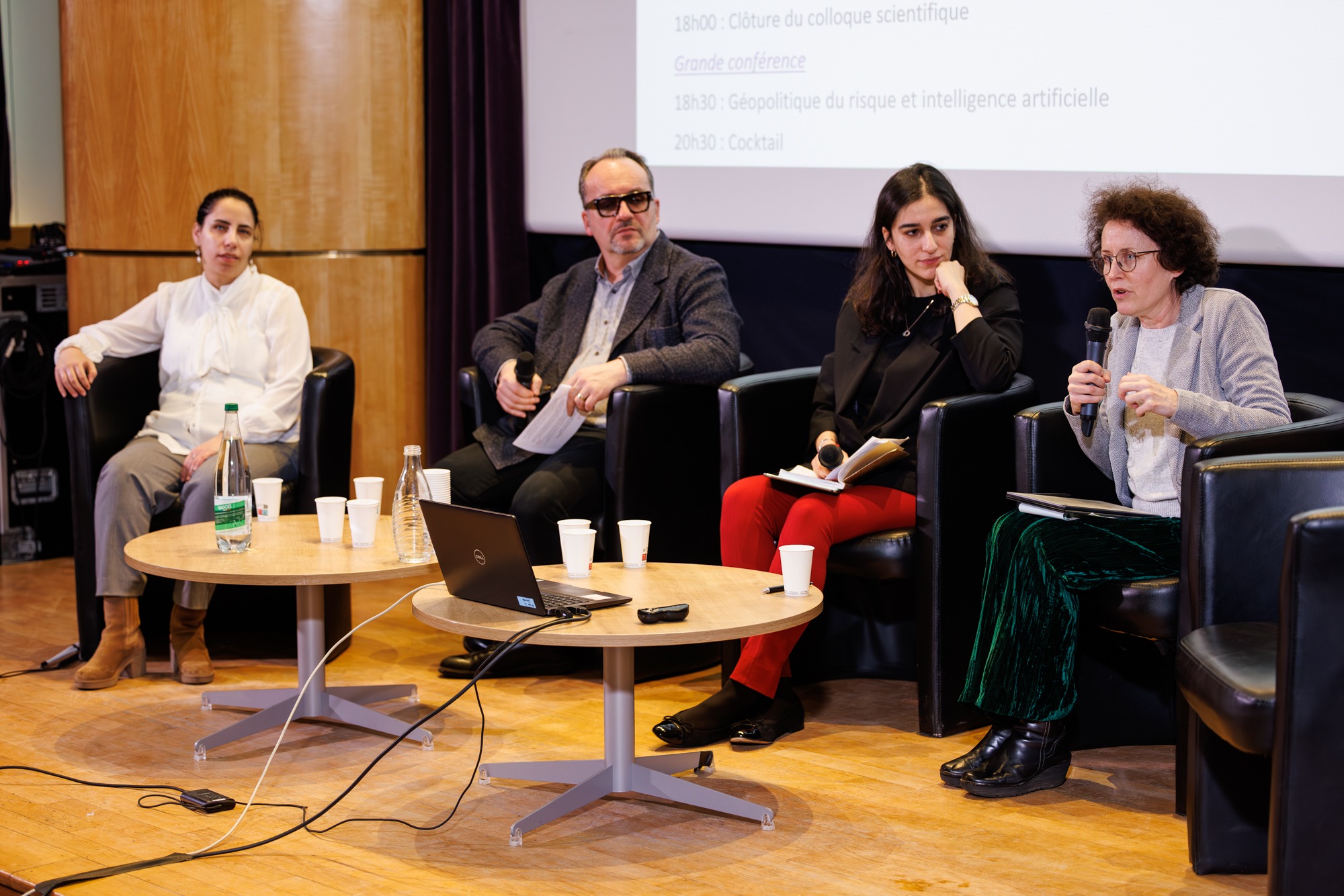
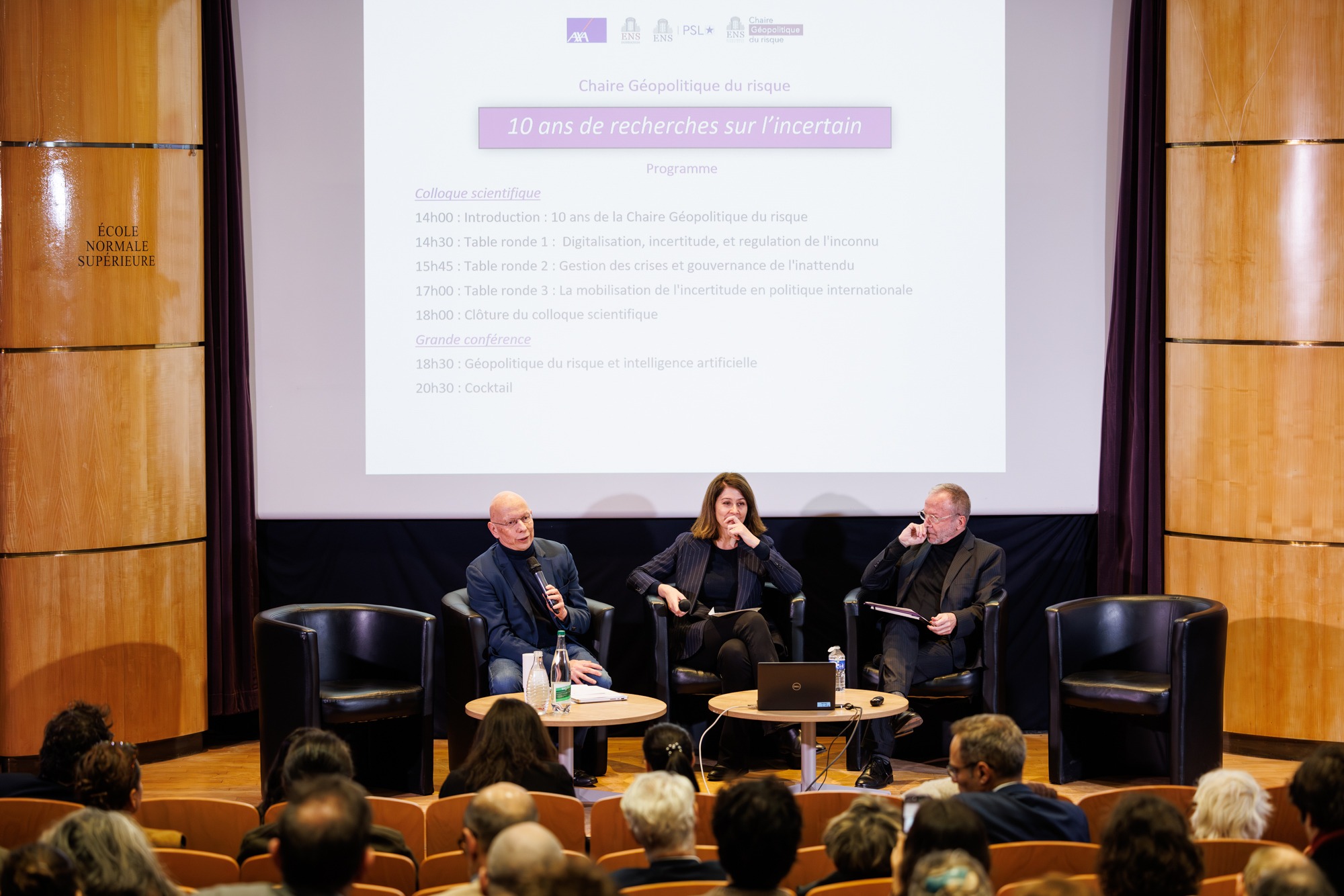
The half-day event then continued with three diverse roundtable discussions, unfolding the different dimensions of the notion of risk:
- Digitalization, uncertainty, and the regulation of the unknown
With A. Rouvroy (University of Namur), J. Atif (École Polytechnique – Institut Polytechnique de Paris), D. Abu-Alyounes (UNESCO), and M. Girel (ENS). Moderated by A. Gizem Yasar (ENS-PSL).
- Crisis management and the governance of the unexpected
With O. Borraz (Sciences Po Paris), M. Corteel (Harvard University), and V. de Geoffray (Groupe Urgence, Réhabilitation, Développement). Moderated by J. Verlin, Deputy Director of the Chair.
- Mobilizing uncertainty in international politics
With A.-L. Amilhat-Szary (University of Grenoble), A. Amicelle (Sciences Po Bordeaux), M. Jumbert (Peace Research Institute, Oslo), and B. Bourcier (Université Catholique de Lille). Moderated by S. Perret (ENS-PSL).
These discussions confirmed the relevance of a cross-disciplinary approach: understanding contemporary risks requires bridging disciplines, scales, and temporalities.
AI at the heart of new geopolitical balances
© Frédéric Albert
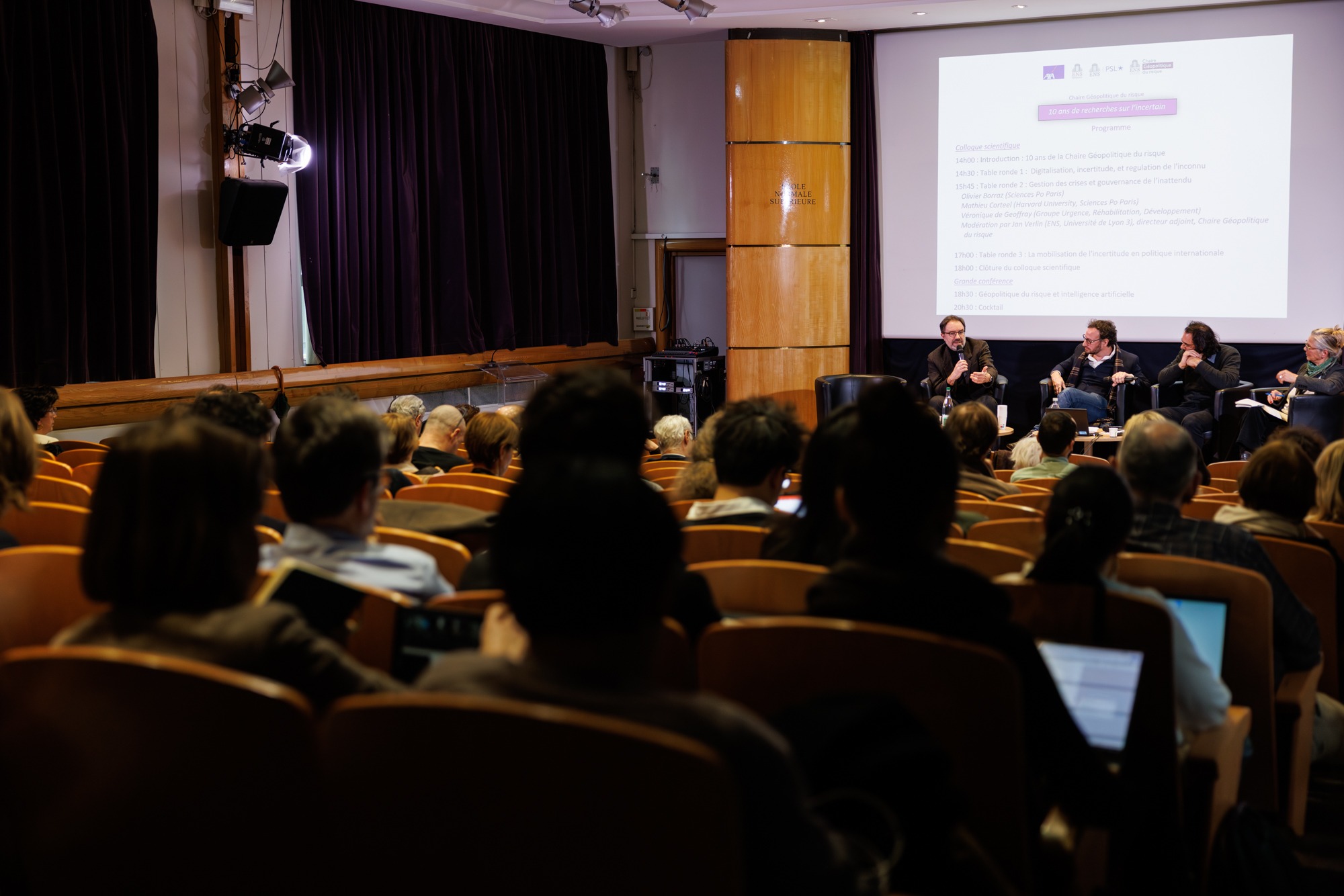
Behind the apparent abstraction of algorithms lie material, energy, and regulatory infrastructures. The question raised was twofold: how should these infrastructures be governed? And how can the rapid pace of technological innovation be reconciled with the slower tempo of political regulation, particularly within the framework of the European AI Act?
The dialogue between researchers and decision-makers illustrated the Chair’s core mission: to produce rigorous analysis of ongoing transformations while shedding light on collective choices.
Sacha Altay (Assistant Professor at the University of Zurich and affiliated researcher at the AI and Society Institute, ENS-PSL); Francesca Musiani (Research Director at the CNRS and Director of the Centre for Internet and Society); Henri Verdier (CEO of the INRIA Foundation); moderated by Constance de Leusse (Director of the AI and Society Institute, ENS-PSL) and Laurent Daudet (Executive Director for AI at ENS-PSL, normalesup.ai).
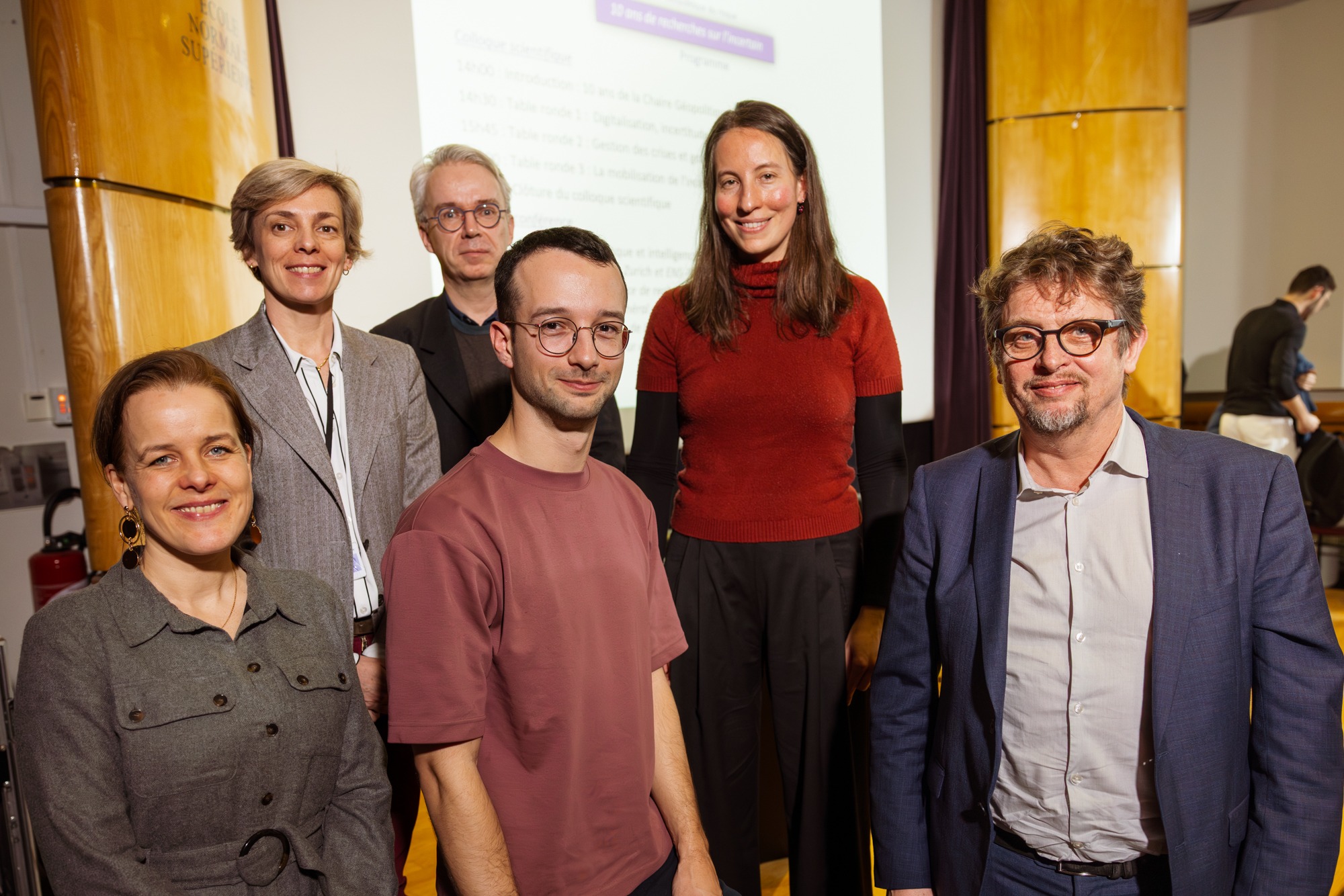
The ENS Foundation thanks its partner for ten years of joint research
© Frédéric Albert
Over the past ten years, the AXA Chair “Geopolitics of Risk” has enabled the recruitment and support of early-career researchers, the organization of regular seminars, and the production of widely recognized research.
The ENS Foundation thanks AXA for its long-term commitment. This partnership has helped establish at ENS a leading center for reflection on contemporary risks, at the intersection of scientific knowledge, technological challenges, and geopolitical transformations.